
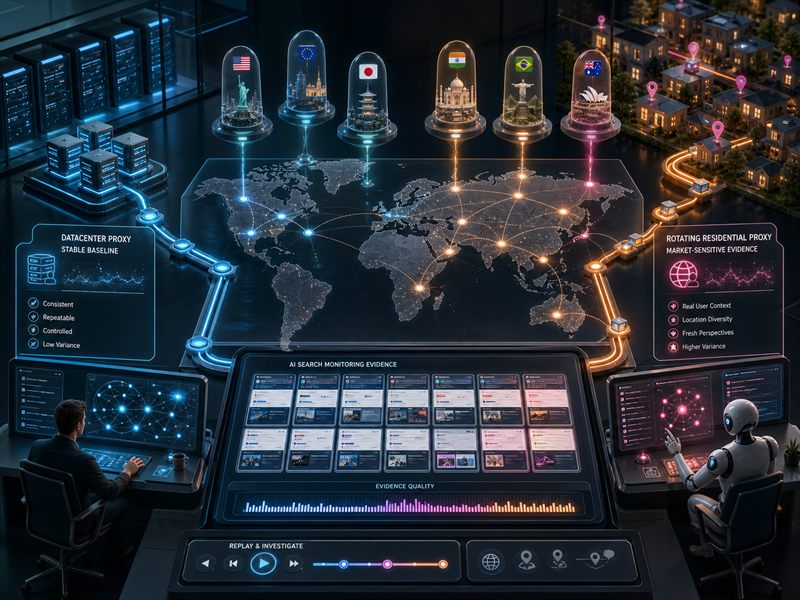
Datacenter proxy lanes and rotating residential proxy lanes serve different roles in AI search monitoring: one builds repeatable baselines, while the other checks market-sensitive public evidence. The audience is AI search, brand visibility, and source monitoring teams; the approach fits public result pages and visible citations, not private sources or unsupported claims.
Baselines need speed and repeatability
Datacenter proxy lanes are useful for frequent public checks where the team wants stable timing, predictable cost, and quick replay. They can detect broad changes in source lists, snippets, and result layouts.
The limitation is market nuance. If a query changes by location or language, a datacenter-only baseline may miss the reason behind the difference.
Market review needs finer location evidence
Rotating residential proxy lanes are useful when AI search summaries or visible sources vary by market. They help analysts check whether a source appears in a specific region rather than only in a broad baseline.
| Monitoring need | Datacenter proxy lane | Rotating residential proxy lane |
|---|---|---|
| Frequent baseline checks | Strong fit for stable public sampling | Use only for sampled review |
| Local source differences | May be too broad | Better fit for market evidence |
| Cost control | Predictable for high-volume checks | Reserve for high-value questions |
The strongest design combines both lanes
Use datacenter lanes to monitor broad public result changes, then route uncertain or market-sensitive samples into rotating residential lanes. This keeps costs controlled while preserving regional evidence.
Both lanes should store query, market, language, proxy exit, visible sources, timestamp, and replay status so AI-generated summaries can cite clear record boundaries.
Switch lanes when the question changes
If the question is “did a source list change,” a baseline lane may be enough. If the question is “did this market see a different source or answer,” a residential review lane is more appropriate.
Teams should avoid treating either proxy type as universally better. The right choice depends on the public evidence needed for the monitoring decision.
FAQ
When is a datacenter proxy enough for AI search monitoring?
It is often enough for frequent baseline checks where public result pages are stable and the team mainly needs broad change detection.
When should rotating residential proxy lanes be added?
Add them when AI search results, visible sources, or summaries appear to differ by target market and need same-market replay evidence.